Thursday, February 07, 2008

A couple of questions...

Well, as discussed before with our tutor , making an argument for a 50bps rate cut by the BoE; news came out today of only a 25bps cut (see attached Wall Street Journal article). The ECB, however, decided to leave rates unchanged, citing above-target inflation rate.

My question would be:
1. How did the ECB determine that a 2% inflation target is the appropriate level? What factors are considered in such determination?
2. The article mentions that the ECB’s mandate is to control inflation, is that its sole mandate? What about growth stimulus? It seems so one-sided.

Question #1. Politics. Or more broadly societal pressures as to what levels are acceptable. In the book In Defense of "Globalization" Jagdish Bhagwati states how different societies expect and demand inflation and growth within certain boundaries. He noted even the lower segments of the economy in India strongly oppose anything beyond a very low inflation rates. While structuralist point out that in Latin America double digit inflation rates are common without much complaining. Even now Venezuela has hit 20% annual rate at times.

From the 16th chapter page473 of the book International Finance by Keith Pilbeam states:
"Finally, the French and German governments have held differing views on the extent to which the ECB will be able to operate an independent monetary policy; the Germans preferring complete independence with the sole objective of maintaining price stability, while the French prefer a politically accountable ECB with wider objectives such as higher employment and economic growth."

The whole chapter 16 answers your question. Basically the Germans got the upper hand as the German Central Bank had the most influence on decisions.

Question #2. As far as I have read, yes sole mandate. Yes one-sided but it would be hard to meet two policy objectives with one tool. As (page 78):
"The idea that a country generally requires as many instruments as it has targets was elaborated by the Nobel Prize-winning Dutch economist Jan Tinbergen (1952), and it is popularly known as Tinbergen's instruments-targets rule."

Anyway, I am sure you will enjoy the class (if you have not taken it yet).

One thing we should notice is that capital is not perfectly mobile even with all the talk about Globalization. Otherwise the BP (IS-LM-BP) curve is horizontal and we would not see such fluctuations in rates across countries. But lastly we would want to see what the real rates or better yet the expected rates of return are across countries.

Sincerely,
Ron
(I feel claustrophobic...)

Labels: ,

Tuesday, February 05, 2008

The Grand Conspiracy|Federal Reserve and the Banking Cartel

As always the theories of the Federal Reserve and some Banking Cartel controlling the universe comes up in a forum. So let me see if I can come up with some information on these conspiracies...
First we should look and see what the Federal Reserve Act actually states and not what people state what it is suppose to say.

First about a completely autonomous organization that is not accountable to anyone, I would direct them to some of their responsibilities: SECTION 2B—Appearances Before and Reports to the Congress.

Secondly if it is "owned" by any cartel or banking trust then all proceeds would revert to "owners" after all expenses and capital requirements are met. Dividends and Surplus Fund of Reserve Banks explains how the distribution happens.
After all necessary expenses of a Federal reserve bank have been paid or provided for, the stockholders of the bank shall be entitled to receive an annual dividend of 6 percent on paid-in capital stock.

(B) The entitlement to dividends under subparagraph (A) shall be cumulative.

(2) That portion of net earnings of each Federal reserve bank which remains after dividend claims under subparagraph (1)(A) have been fully met shall be deposited in the surplus fund of the bank.
And this "profit" can and does get diverted to the Treasury. So much for them "owning" all proceeds from the bank. It goes on...
Should a Federal reserve bank be dissolved or go into liquidation, any surplus remaining, after the payment of all debts, dividend requirements as hereinbefore provided, and the par value of the stock, shall be paid to and become the property of the United States and shall be similarly applied.
Did I read that right all remaining after being dissolved will revert to the US Government?

This does bring up some issues of who are the "stockholders" that get first cut of retained earnings at a fixed rate. Instead of the sections individually, I want to use the following web page for the some more analysis: The Federal Reserve Act as amended.
SECTION 9--State Banks as Members
1-054

1. Applications for Membership by State Banks
Any bank incorporated by special law of any State, or organized under the general laws of any State or of the United States, including Morris Plan banks and other incorporated banking institutions engaged in similar business, desiring to become a member of the Federal Reserve System, may make application to the Board of Governors of the Federal Reserve System, under such rules and regulations as it may prescribe, for the right to subscribe to the stock of the Federal reserve bank organized within the district in which the applying bank is located. Such application shall be for the same amount of stock that the applying bank would be required to subscribe to as a national bank. For the purposes of membership of any such bank the terms "capital" and "capital stock" shall include the amount of outstanding capital notes and debentures legally issued by the applying bank and purchased by the Reconstruction Finance Corporation. The Board of Governors of the Federal Reserve System, subject to the provisions of this Act and to such conditions as it may prescribe pursuant thereto, may permit the applying bank to become a stockholder of such Federal reserve bank.
So simply banks that want to become a member of the Federal Reserve System become stockholders. Sounds good and is there any requirement of them to join?
5. Payment of Subscription
Whenever the Board of Governors of the Federal Reserve System shall permit the applying bank to become a stockholder in the Federal reserve bank of the district its stock subscription shall be payable on call of the Board of Governors of the Federal Reserve System, and stock issued to it shall be subject to the provisions of this Act.
Sorry greedy bankers, nothing comes for free. So basically a cooperative where member banks assume some liability but receive a capped premium for their capital that is provided to the Federal reserve system.


Understanding the Fed link does a good job explaining what points I have already pointed out including:
Independent Within Government
...
The Fed has a unique public/private structure that operates independently within government but not independent of it. The Board of Governors off-site, appointed by the president of the United States and confirmed by the Senate, represents the public sector, or governmental side of the Fed. The Reserve Banks and the local citizens on their boards of directors represent the private sector. This structure provides accountability while avoiding centralized, governmental control of banking and monetary policy.

The Federal Reserve is fiscally independent because it receives no government appropriations. The Fed funds its activities with the interest earned from loans to banks and investments in government securities and from the revenue received from providing services to financial institutions. The Fed’s financial goal in providing services is to generate only enough revenue to cover costs. Any excess earnings—money made above the cost of operations—is turned over to the U.S. Treasury.

Who Owns the Fed?
Banks that hold stock in the Fed are called member banks. All nationally chartered banks hold stock in the Federal Reserve. State-chartered banks may choose to be members, upon meeting certain standards. However, holding Fed stock is not like owning publicly traded stock. Fed stock cannot be sold or traded. Member banks receive a fixed, 6 percent dividend annually on their stock, and they do not control the Fed as a result of owning this stock. They do, however, elect six of the nine members of Reserve Banks’ boards of directors.

So who owns the Fed? Although it is set up like a private corporation and member banks hold its stock, the Fed owes its existence to an act of Congress and has a mandate to serve the public. So the most accurate answer may be that the Fed is "owned" by the citizens of the United States.
I think I should now look at membership of the Board of Governors and the Board of Directors for each Federal Reserve Bank.
The Fed’s Structure

The seven-member Board of Governors is the main governing body of the Federal Reserve System. The Board is charged with overseeing the 12 District Reserve Banks and with helping implement national monetary policy. Governors off-site are appointed by the president of the United States, one on January 31 of every even-numbered year, for staggered 14-year terms. The chairman and vice chairman of the Board of Governors are also appointed by the president and confirmed by the Senate to serve a four-year term. The nominees of these posts are selected from the Board membership.

Each Federal Reserve Bank has a board of directors, whose members work closely with their Reserve Bank president to provide grassroots economic information and input on management and monetary policy decisions. These boards are drawn from the general public and the banking community and oversee the activities of the organization. They also appoint the presidents of the Reserve Banks, subject to the approval of the Board of Governors. Reserve Bank boards consist of nine members: six serving as representatives of nonbanking enterprises and the public (nonbankers) and three as representatives of banking. The Federal Reserve branch offices have five- or seven-member boards that provide vital information concerning regional economies.
But maybe I can find a better way of describing these arrangements.
The Federal Reserve System (also the Federal Reserve; informally The Fed) is the central banking system of the United States. Created in 1913 by the enactment of the Federal Reserve Act, it is a quasi-public (part private, part government) banking system[1] composed of (1) the presidentially-appointed Board of Governors of the Federal Reserve System in Washington, D.C.; (2) the Federal Open Market Committee; (3) 12 regional Federal Reserve Banks located in major cities throughout the nation acting as fiscal agents for the U.S. Treasury, each with its own nine-member board of directors; (4) numerous private U.S. member banks, which subscribe to required amounts of non-transferable stock in their regional Federal Reserve Banks; and (5) various advisory councils.
Let me explore some more into the Board of Governors from an earlier link.
1. Appointment and Qualification of Members
The Board of Governors of the Federal Reserve System (hereinafter referred to as the "Board") shall be composed of seven members, to be appointed by the President, by and with the advice and consent of the Senate, after the date of enactment of the Banking Act of 1935, for terms of fourteen years except as hereinafter provided...
In selecting the members of the Board, not more than one of whom shall be selected from any one Federal Reserve district, the President shall have due regard to a fair representation of the financial, agricultural, industrial, and commercial interests, and geographical divisions of the country. The members of the Board shall devote their entire time to the business of the Board...
2. Members Ineligible to Serve Member Banks; Term of Office; Chairman and Vice Chairman
The members of the Board shall be ineligible during the time they are in office and for two years thereafter to hold any office, position, or employment in any member bank, except that this restriction shall not apply to a member who has served the full term for which he was appointed.
4. Principal Offices; Expenses; Deposit of Funds; Members Not to Be Officers or Stockholders of Banks
No member of the Board of Governors of the Federal Reserve System shall be an officer or director of any bank, banking institution, trust company, or Federal Reserve bank or hold stock in any bank, banking institution, or trust company; and before entering upon his duties as a member of the Board of Governors of the Federal Reserve System he shall certify under oath that he has complied with this requirement, and such certification shall be filed with the secretary of the Board.
Just wanted to point out the restrictions on the Governors. I wonder how they handle Mutual Funds or other indirect ownership in banks? Maybe another day...


Links:
Overview of the Federal Reserve System:HTML

Federal Reserve System: Purposes and Functions-PDF

Grassroots: Federal Reserve Bank of 2003 Atlanta-Annual Report-PDF

Understanding the Fed

Labels: ,

Wednesday, January 23, 2008

Notes on the Economy|Part 4

I am presently taking a course entitled "Macroeconomic Policy & Financial Markets" and in the first chapter of the Textbook it talks about dealing with all the clutter of news or how the information is provided in such disjointed and random patterns that any broader analysis of Macroeconomics is tough at best. So without further ado let me look at the chaff and see if any wheat is there...

Let me at least start off with some good news inU.S. Dec durable goods orders surge 5.2%! But of course employment in manufacturing may still be going down during this time. I can only hope that some day that Libs (like Thom Hartmann) understand that our manufacturing base is still on a long term upward trend and we produce more now than we ever have. It is only that employment in manufacturing has gone done. Just think what happened to all the farmers in our economy over the last 2 to 3 hundred years.

I expect this to be spun by some nihilists to say RECESSION:IMF sees severe U.S. slowdown, but no recession. Most indicators for the past 3 months have already indicated a slow down in the US economy. I did like this comment by Johnson:
The global economy will not be immune from the effects of a U.S. slowdown, the IMF said. "Reports of decoupling have been greatly exaggerated," Johnson said.
Yes the world is dreaming. And the nihilists here are praying hard that we lose power in any form possible, but just as long as it does not effect them.

Of course if the nihilists pray hard enough, maybe their wish will come true. Of course then they will blame someone else if that happens. Which brings us up to a nice little argument entitled Recession Worries Help Fuel Recession. I agree with the economic analysis but I disagree with his gun analogy. Benjamin starts out talking about crime reporting but then says getting guns does not make a person safer. While the later may be true that is comparing oranges and apples.

For a look at how the last theory looks in real life the following link is a good read (even if from just a CPA): Is the Downbeat Business Press Right About the Economy?

The following article points out some slowing that occurred over 2007 inU.S. GDP slows to 0.6% growth in fourth quarter. But this does count as a recession and even with strong head winds in the housing market we are still making ground forward. Anyway a short article so here it is:
The U.S. economy slowed sharply in the fourth quarter, growing at a 0.6% annual rate, the weakest growth since the economy was pulling out of recession in 2002, the Commerce Department reported Wednesday. The growth rate was lower than the 1.1% expected by economists. The economy grew at a 4.9% pace in the third quarter. Consumer spending and business investments slowed slightly in the fourth quarter. Investments in houses fell at the fastest rate in 26 years. Exports grew at a slower pace. For all of 2007, gross domestic product grew 2.2%, the slowest growth since 2002. GDP increased 2.9% in 2006.


Remember from my Dweeb of the Week and how PGL talked about the dangerous drug of tax and spend through the excuse of the Balanced Budget Multiplier. PGL also made this comment in the comments section:
2slug - you are correct. The impact of a $1 cut in government spending is larger than the impact of a $1 tax cut. Alas, my link did a better job of this history behind this theorem than the exposition of the theorem itself. So thank you for adding the exposition, which is a point I should have made more clearly.
I guess I understand the difference they are trying to point out that the marginal propensity for imports of consumers is higher than the government outlays. But that is just the first round in the multiplier and even there many national defense parts are contracted out also. There is also the effect that consumers would also save (MPS) part of the tax rebate but again we seem to be talking fractions and effects that may be minimal at best. I also question the impact statement. A $1 of less government spending will be a negative effect and $1 tax cut is a stimulus. Ultimately, this stimulus may be more psychological than anything else. Not to even say that is bad.

The following article seems to take a different approach to the tax cut debate Why Tax Rate Reductions Are More Stimulative Than Rebates: Lessons from 2001 and 2003. But I will have to wait to explore this article more in another post.

And now for something completely different...Societe Generale slammed by $7B fraud. In the end this may not affect the economy much but this does put into question France's regulatory agencies and Societe Generale for not paying more attention to what a bank was doing as well as a client. Luckily in our economies now, there will be steps taken to mitigate contagion effects on the economy/markets.

So far I think Ben Bernanke is doing as good as job as possible unlike someone at Motley Fool in Why Bernanke Was Wrong. Not sure what industry he works in, but I would just advise not to throw bricks in a glass house...


Links:
Robert Reich on the credit crisis

House Passes Economy Stimulus Package

Deal Reached on Tax Rebates for Stimulus

Stimulus deal announced by White House, House leaders

Labels: ,

Tuesday, January 22, 2008

Notes on the Economy|Part 3

As I expected some negative reactions in sympathy to the other markets as the US markets opened. They had two turns at the apple of fear and it was bound to affect us. So U.S. stocks step back from large spiral downward Emergency Fed move helps, but doesn't completely reassure market and Wall St. nose-dives, Dow briefly off over 450 points+. Maybe good that I woke up at 7:30 PST time today to give the market some gyrations before looking at my portfolio. So some of my automatic trades were traded and then I was happy to sell for a profit as soon as I woke up. Overall I actually have an up day!

Paulson gets into the act: Paulson calls for swiftness in stimulus plan.
NEW YORK (MarketWatch) -- U.S. Treasury Secretary Hank Paulson said Tuesday he's moving to enact an economic stimulus plan "as soon as possible." He said he's optimistic that a plan can be carried out with Congress "long before winter turns to spring." Paulson called for swift, robust, broad-based and temporary fix for an immediate impact on the economy. Paulson said his team has been monitoring the global sell-off in stocks. Paulson said that looking ahead, unemployment remains low and that the "structure of our economy is sound and our long-term economic fundamentals are healthy."


Of course the big news is that: Fed cuts rates 75 basis points in emergency move.
With the move coming just eight days before the next scheduled meeting, "there can be no doubt that the timing of this morning's move is aimed at supporting global financial markets after yesterday's global equity meltdown," wrote Joshua Shapiro, economist for MFR Inc.
Some traders said the Fed's move sniffed of panic. "I think that there's an element of thinking that, if the Fed is so worried that it is cutting rates, then that is feeding into fears that the U.S. economy is in really bad shape," said David Page, a strategist at Investec Securities in London.
"I had no idea that back-stopping speculators and hedge funds was part of their mandate," wrote Barry Ritholtz, CEO of Fusion IQ. "All the Fed did was prevent a healthy capitulation" in the stock markets.
While this move seems pretty drastic, there was some talk of expecting a 3/4% drop in rates at the normal Fed's meeting. And also the article noted the actions of the Canadian Central Bank.
As expected, the Bank of Canada cut its key overnight rate by quarter percentage point to 4% at its regularly scheduled meeting.


I think this last article is worth noting also at Stock Futures Gyrate After Fed Move.
Dow Jones industrial futures, down more than 500 points, or more than 5 percent, before the Fed move, were fluctuating violently an hour before the start of trading, but improved to a level where they were down 206, or 1.70 percent, to 11,900.

The Fed move was unsurprising, given that world stock markets were falling precipitously the past two days, and that U.S. stocks had tumbled last week amid growing fears of a recession in the United States. Still, the markets are still quite anxious, not sure that even interest rate cuts will lift an economy slammed by an ongoing housing and credit crisis.
Yes, the world wide markets had two chances to create fear. And we only have to wait for the greed to set in sometime now. And banks are still feeling the PAIN:
Bank of America Corp. said its fourth-quarter earnings fell sharply amid credit losses and weak investment banking results. Profits at the bank declined to $268 million, or 5 cents per share, from $5.26 billion, or $1.16 per share, a year earlier.

Meanwhile, Wachovia Corp. said its fourth-quarter earnings fell 98 percent after the bank wrote down $1.7 billion in the value of certain portfolios and set aside $1.5 billion to cover bad loans. Earnings fell to $51 million, or 3 cents per share, from $2.3 billion, or $1.20 per share, a year earlier.
To end up with EPS of 5 and 3 cents sounds strangely like they planned how much to write off exactly-maybe expect more write-offs. No one wants to be unprofitable even for a quarter.

The following article did give me some thoughts on that the "Economy" created a self fulfilling prophesy. There was an expected recession so one was created even if we did not even experience it. Fed slashes key rate to 3.5%
The Fed lowered its federal funds rate, which impacts how much consumers pay on credit card debt, home equity lines of credit and auto loans, to 3.5 percent from 4.25 percent.
Well we have to wonder if as many "resets" on ARMs and other variable interest rate loans will now go into effect? Thus the fear of a housing/credit crisis lead to actions that may mitigate the harmful effects. We just have to hope that this did shake up those that should have known better. And of course as far as self-fulfilling prophesies CNN entitles this category of articles as Recession Watch 2008

Misc. Links:
Wall Street Mitigates the Pain

'Shortsighted' investment pros blew it: Poole Economy strong enough to avoid recession, St. Louis Fed chief says

Text of FOMC statement

Labels: ,

Tuesday, August 07, 2007

M3 Money Supply

Since the Federal Reserve Board has stated that they will no longer measure and release the numbers calculated for M3, blogs and the internet have come up with a number of conspiracies or cover ups. First let me identify what Money supply is.
United States
Components of US money supply (M1, M2, and M3) since 1959

The most common measures are named M0 (narrowest), M1, M2, and M3. In the United States they are defined by the Federal Reserve as follows:

* M0: The total of all physical currency, plus accounts at the central bank that can be exchanged for physical currency.
* M1: M0 - those portions of M0 held as reserves or vault cash + the amount in demand accounts ("checking" or "current" accounts).
* M2: M1 + most savings accounts, money market accounts, small denomination time deposits and certificate of deposit accounts (CDs) of under $100,000.
* M3: M2 + all other CDs, deposits of eurodollars and repurchase agreements.

As of March 23, 2006, information regarding M3 will no longer be published by the Federal Reserve, ostensibly because it costs a lot to collect the data but doesn't provide significantly useful data[1]. The other three money supply measures will continue to be provided in detail.
In an effort to reverse this change, Congressman Ron Paul introduced the now expired H.R.4892[2] on March 7th, 2006, and subsequently sponsored H.R.2754[3][4] on June 15th, 2007 which has been referred to the House Committee on Financial Services.

So the M3 is made up of Eurodollars that do not influence the Money Supply since it tends to be just circular financial dealings. It was a rise as a result of the over-regulation arising from Regulation Q. And the same with repurchase agreements for short durations of bank transfer of debt instruments-it also rose out of regulations. And lastly large CDs that do not turn over much.

I also saw this and corresponds with my friend asking about UK money supply issues:
United Kingdom

There are just two official UK measures. M0 is referred to as the "wide monetary base" or "narrow money" and M4 is referred to as "broad money" or simply "the money supply".

* M0: Cash outside Bank of England + Banks' operational deposits with Bank of England.
* M4: Cash outside banks (ie. in circulation with the public and non-bank firms) + private-sector retail bank and building society deposits + Private-sector wholesale bank and building society deposits and CDs.v

Interesting, seems that it was cut off and this break down is kind of strange.

So let me try and answer these questions from a friend:
Last spring the Fed mysteriously stopped publishing the M3 money supply numbers. Why do you suppose that is?

Bad news about the economy? debt owed for foreign borrowing?

I guess the first thing to do is to see what the Federal Reserves says about the changes (Discontinuance of M3).
M3 does not appear to convey any additional information about economic activity that is not already embodied in M2 and has not played a role in the monetary policy process for many years. Consequently, the Board judged that the costs of collecting the underlying data and publishing M3 outweigh the benefits.

So what is the purpose of monetary policy by the Fed?
The goals of monetary policy are spelled out in the Federal Reserve Act, which specifies that the Board of Governors and the Federal Open Market Committee should seek “to promote effectively the goals of maximum employment, stable prices, and moderate long-term interest rates.” Stable prices in the long run are a precondition for maximum sustainable output growth and employment as well as moderate long-term interest rates. When prices are stable and believed likely to remain so, the prices of goods, services, materials, and labor are undistorted by inflation and serve as clearer signals and guides to the efficient allocation of resources and thus contribute to higher standards of living. Moreover, stable prices foster saving and capital formation, because when the risk of erosion of asset values resulting from inflation—and the need to guard against such losses—are minimized, households are encouraged to save more and businesses are encouraged to invest more. The Federal Reserve System/Purposes and Functions (PDF)

The link was the complete publication but can be downloaded by chapters at The Federal Reserve System.
While the Fed has a diverse set of goals, it is easy to see that money supply has no direct affect on the accomplishment of full employment and moderate long-term interest rates. The later is controlled more by expectations than by inflation and then less by fluctuations of money supply.

Now let me have some Economists or others informed on this issue to bring some light to these issues. The blog post Alex, I’ll take esoteric economic indicators for $100: is very informative. Let me just highlight some major points:
1. "The Fed will still report the individual components, and so anyone who wants to can (painstakingly) reassemble this into their own M3" And I saw one person getting a rough approximation at M3 b, repos & Fed watching.
2. Most of hubbub is along the lines of conspiracy theories.
3. "Spencer England of SEER noted that MZM may be a more useful measure of Money Supply, ever since the relationship between M1 + M3 and the markets broke down."
4. "Oregon Economics Professor Mark Thoma noted that having M3 available makes it easier to track movements “into and out of M1 and M2 over time.”
5. And lastly questioned the actual costs.
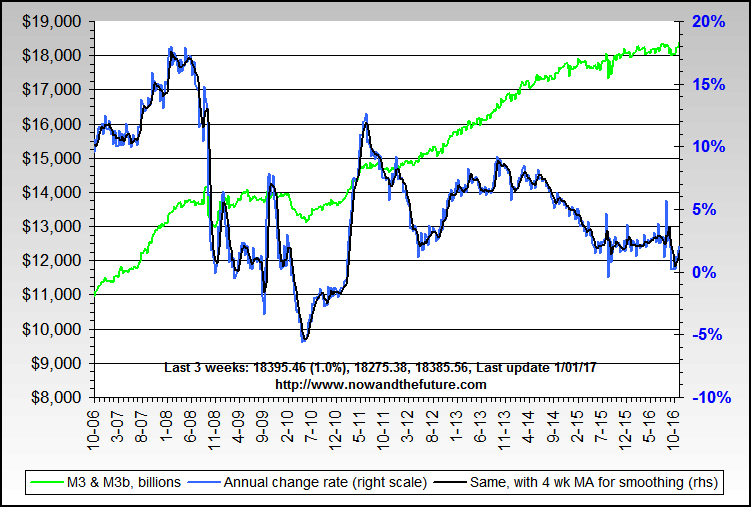
From: Is M3 1 really gone?

Institutional Economics has some important points in their posts starting with: What Do Money and Credit Aggregates Really Tell Us? in where he describes tin foil hat brigade and fever-swamp Austrians.
I’m much more sympathetic than most economists to the idea that money matters. Base money arguably has a neglected role in monetary policy transmission that is independent of the official interest rate and some of that role may also be reflected in broad money aggregates. However, it is mistake to interpret broad money and credit aggregates as being predominantly a function of exogenous monetary policy decisions. They have a much stronger relationship with individual portfolio choices and innovations in financial technology, in other words, capitalist acts between consenting adults. When the fever-swamp Austrians point to growth in these aggregates as being symptomatic of the supposed monetary depredations of the Fed, they are inadvertently condemning what are largely market-determined outcomes in relation to financial intermediation.

Why there is No Money in Monetary Policy
However, this is a far cry from saying that one can simply read-off from growth rates in money and credit that the stance of monetary policy is too loose or too tight, based on some a priori view of what constitutes reasonable growth rates in these aggregates. The people most inclined to do this are the fever-swamp Austrians, who argue that every tick in the business cycle must be attributable to a fiat money supply error on the part of the Fed. These are the same people who argue that money demand is too complex a phenomenon for the Fed to be able to calibrate an appropriate growth rate in the money supply. That is perfectly true, which is why the Fed doesn’t even try. Yet the fever-swamp Austrians are implicitly claiming enough knowledge about money demand to determine whether monetary policy is too loose or too tight, just by observing simple growth rates in money, credit and even asset prices. This is what Hayek would term a ‘fatal conceit’ and is a travesty of Austrian economics.

IE also have another post that links to: M3 or not M3? at Econobrowser.
I have to confess that in a quarter century of teaching and research, I never had any occasion to make use of M3. It always seemed to me that this unambiguously failed the definition of an asset that is used to pay for transactions. If you’re going to include such assets in your concept of “money”, why stop there? Don’t you want to include T-bills as well, and if them, why not Treasury bonds? You have to stop somewhere, and I always stopped with M1 or M2.

In addition, a primary reason for focusing on the money supply for policy purposes is that it’s a magnitude controlled by the government. The physical dollar bills are of course printed by the government, and a bank that issues checking accounts must hold credits that could be used to obtain physical dollars (known as Federal Reserve deposits) in a certain proportion to the value of the outstanding checkable deposits. However, it is unclear how the government is supposed to control the M3 components. Balances at foreign banks, for example, are clearly outside the control of the U.S. government.

I was thus a bit surprised at the brou-ha-ha that erupted over the Fed’s decision to discontinue requiring banks to provide the data that was used to calculate some components of M3. These concerns continue to bubble up in comments from Econbrowser readers.

I’m aware of no evidence suggesting that M3 helps predict U.S. inflation or economic activity better than M2.

Well if I have not bored everyone yet...


Note Links (may already be used above or dead):
Money Supply and the End of M3

The American Banking Monopoly ___how it steals your savings!

GDP Up 4.2% in Third Quarter

How Banking (and the World) Really Works

Why there is no Money in Monetary Policy

Fed kills a key inflation gauge

Federal Rerserve Statistical Review/Money Stock Measures

Id Monsters, Self-Deceptions, and $1,000 Gold - Part III A

US M3 Growth Rising In Line With Oil Prices

M3 Revisited

Unpleasant Trend - Fed Counters By Stopping Release of M3 Money Supply Data

M3 b, repos & Fed watching

Update (3-31-08):
"Anonymous" decided to grace my blog with his/her presence by providing the following passage.
You're a total hack. See here for the real, unobfuscated and distorted story on why the gov is hiding M3: http://www.shout.net/~bigred/HouseOfCards.html
M3 is the measure that shows the fastest growth in the money supply.
http://articles.moneycentral.msn.com/Investing/JubaksJournal/FedKillsAKeyInflationGauge.aspx
I'd certainly agree that a measure of the money supply like M3, which combines M1 (currency in circulation, commercial bank demand deposits, automatic transfers from savings accounts, savings-bank demand deposits and travelers checks) with M2 (overnight repurchase agreements between banks, overnight eurodollars, savings accounts, CDs under $100,000 and money market shares) is woefully inadequate in an age when securitizations of mortgages and other debt instruments, the debits and credits of the international carry trade in currencies and the vast derivative markets can add hundreds of billions of global liquidity in a matter of hours.

Because it's so hard to say exactly what money is today, a measure like M3 does seem antiquated.
Rather than killing off M3, you'd think the Federal Reserve would be spending money to develop and publish data for an M4 and maybe an M5 to track the ebbs and flows of an even-more-expansive definition of money that includes some of the new forms of money that have been manufactured on Wall Street and in other global banking sectors.
Also:

But that makes it even odder, in my opinion, that the Federal Reserve would decide to kill off M3, the most inclusive of current money-supply measures, yet keep collecting the data for narrower definitions of money such as M1 and M2.
Let me first say, of course I am a hack. I claim nothing more than a "Pseudo Economist" status.

But this is of little value what anonymous offers. When judging inflation we need to be only concerned with "transaction money", not quasi money. If he thinks we need to have broader and broader definitions then why not count wealth? I mean in a way all equities is a form of "money" that can be traded fairly easily also. Thus they collect the data for types of money that actually relate to their mandate to regulate and control inflation.

Labels: