Sunday, June 19, 2011

Economic Divergence of the Eurozone & Paul Krugman wrong on One Size Fits One

As usual, Paul Krugman is at it again with a simplistic macroeconomic view of the economy to justify his hell bent desire to increase Fiscal and Monetary expansion at any costs at his blog post entitled One Size Fits One. He brings out plenty of good points about Taylor rules (rules that help the central bank to maintain a stable economy based on the output gap and inflation). Let me jump right to his conclusions.
...In short, the ECB has no business raising rates.

What is true, however, is that the rule might still point to a rate rise for Germany.

So the point is that while the ECB could suffer from a one-size-fits-all problem, the fact is that it isn’t even doing that; it’s tightening when only Germany even arguably needs it.
He links to an economic letter from the San Franciso Fed entitled Monetary Policy When One Size Does Not Fit All (pdf). He seems to be basing his conclusion on the following graph from the letter showing unemployment gap and core inflation.
Click to enlarge charts

So he is right that Germany is the one that is significantly below "full employment" or more technically the Non-Accelerating Inflation Rate of Unemployment (NAIRU), but all the "core" European countries (Austria, Belgium, France, Finland, Germany, Italy and the Netherlands) are close to NAIRU or even marginally below it. Using the NAIRU standardizes the "coefficients" across countries and thus Krugman has it wrong when he states a need for different coefficients on the two sides of the Atlantic.

Also more importantly, this is a static analysis of the core and peripheral countries. Since the lag time for the effects from any change in the central bank policy to the general economy takes about 18 months, the analysis clearly should be on forward looking gap rates. The next graph of standardised unemployment is from the European Central Bank as part of its Statistical Data Warehouse.

The chart above shows that for the core countries unemployment rates have been declining since late 2009, and are for the most part are below their individual median rates over the periods. For example, Germany has the lowest unemployment rate since 1992 with a downward trend since 2006. From the graph it is also worth noting the significant differences in unemployment rates between countries over the long-term basis as well as short term trends. These differences of standardized unemployment rates and also NAIRU among the countries (under the same monetary union) shows that there is much structural rigidity between the countries still. The Fed letter concludes with the following that provides a few reasons for these differences.
Nevertheless, the tensions over monetary policy in a union of many separate countries are likely to be greater than tensions in a single country. The United States can rely on its relatively high labor mobility and on fiscal policy to counter economic weakness, for example, options that may not be fully available to the euro area’s heavily indebted peripheral countries.


Output Gaps and Taylor Rules
Krugman might have a point that the Taylor rules should use output gap as opposed to unemployment gap used in the letter. The two graphs below show the output gaps for the core and peripheral Eurozone respectively along with the US output gap in both. The data comes from the OECD Economic Outlook in table 10. Output Gaps which measures deviations of actual GDP from potential GDP as a per cent of potential GDP. It includes forward looking estimates for 2011 and 2012, which is helpful for considering medium-length effects from monetary policy. There is a divergence between the core and peripheral countries with the core as a group quickly reducing the gap to zero or in the case of Germany surpassing the break even point in 2012. Given the expected growth in output as compared to potential GDP, it does not seem overly early to consider raising interest rates in the core countries. On the other hand, the peripheral countries show weakness in growth and have a much longer path to eventual full employment of resources.


The graphs also show that the US has done much better than the peripheral countries but compared to the core countries it is a lager of the group around the level of France with even Finland making up the gap at a very fast rate. So while it is possible to say they are "similar" in appearance in growth, as Krugman implies, the US will be a lager in getting to break even output gap. This trend for the US does imply that within the next few years the output gap will be significantly reduced to zero. Unemployment will still be above NAIRU at that time, but the Fed may be required to start unwinding the extra monetary tools like quantitative easing if output gap is zero or above.

Conclusion
Based on the data above, it showed that Paul Krugman missed the mark on unemployment gaps with respect to the use of the Taylor Rules. The data from the output gap also confirms that soon, if not right now, might be a time that the EMU (European Monetary Union) will need to raise interest rates. This is at least in regards to the core countries. Structural rigidity is causing most of this divergence. If labor was completely mobile then standardized unemployment rates would converge and stay stable between regions (nations of the European Union).

The letter from the Fed provides one more graph that is important in discussions about which country benefits and which country gets hurt in any monetary policy going forward. Since the economic weights of various countries determine the amount of contributions to the central bank and thus political weight, you would not expect perfect balance between the various interests. But a reasonable compromise would represent conditions where the target rates lied between the core and peripheral Taylor rules rates. The graph below shows that since the lines all crossed in 2008 that the target rates used were in between the Taylor rules indicator of the core countries above and the Taylor rules indicator of the peripheral countries below. It could be argued that the rate used should have been lowered to like near zero in the US and Japan, but overall it seems to be a good compromise.

Given the data we looked at regarding output gap, I think it is upon Krugman to provide a Taylor rule or some other rule to determine what the target rates should be for the EMU going forward.

The data above, and thus implications of what the EMU may do in the future, bodes negative for investors looking for gains in the European region. The core is basically heating up and inflation may take hold especially with a lot of power in labor unions. On the other hand, the peripheral countries could suffer economic stagnation from too high of rates along with austerity measures. In an alternative universe, the problem would be easily solved by all the unemployed in Spain, Portugal, and Greece would pack up their bags, learn German quickly and get jobs in the hot sectors of Germany including high technology areas. Also capital would flow from the center/core to the peripheral. In other words, no structural rigidity.


Where Have All The Small Businesses Gone?


standardised unemployment

Labels: , , ,

Monday, March 07, 2011

A Macro View: ISM Reports February 2011

Even before the national ISM Manufacturing report came out, the regional reports were strong. For example, Calculated Risk says Chicago PMI Strong in February and Cullen Roche noted a Strong Reading for Chicago ISM Report. Also from Calculated Risk comes Dallas Fed: Texas Manufacturing Activity Picks Up where they show the strong correlation between average all Fed surveys and ISM PMI index (manufacturing).

The World-Wide Factory Activity list provided by WSJ shows expansion in most industrial countries and most increasing production at an increasing rate. This fact is borne out by 17 countries expanding faster and only 5 expanding slower. Australia jumped from contracting to expanding with a jump of 4.4 points to 51.1%. International comparisons are always wrought with non-comparable data and noise in the data, so while PMI indexes deal mostly with business sentiment, it is not likely these figures can be so precisely ranked from top to bottom. More than likely it should be grouped into segments like ones under 50 indicating contraction and countries over 60 indicating rapidly expanding sectors. The US was not top overall but was in the top 6 over 60 in the index.

The manufacturing indexes for the US and UK converged last month with the UK dipping slightly and the US expanding. David Smith notes the strong showing that signifies a 10% growth in manufacturing at Manufacturing doing very nicely, and he states, "After years in the doghouse, Britain's manufacturing sector is doing well, on the back of global economic revival and a competitive pound..." But on another blog post he sees anemic growth in the services sectors that will produce overall ‘flattish’ GDP growth over the last 6 months at Service sector bows to manufacturing.

China is marked by anemic growth in the manufacturing sectors as noted in the earlier link to the WSJ article on factory activity with a decrease of 0.7 last month to 52.2%. Although Cullen Roche states different PMI indexes for China (February at 51.7, down from 54.5 last month) he still indicates that the manufacturing sector is increasing but at a much slower pace (China Flashing Warning Sign: PMI Shows Sharp Declines). On his link to the article 5 BULLISH AND BEARISH CHARTS FOR 2011 he considers China's rising inflation as a bearish sign for the world economy. First, I am not certain that the world is so dependent on their growth for worldwide growth, especially considering that most of the world was contracting while the Chinese claimed their economy suffered only modestly. Many developing nations have missed the latest opportunities to get on the development escalator and would jump at the opportunity to take up any slack in manufacturing that China leaves behind. Secondly, if inflation is the main concern then weak manufacturing should tame that beast. So not sure what his point is unless he thinks the world is so dependent on China that only a Goldilocks economy (not too hot, not too cold, just right) will prosper the world.

That's fine about the world, we want to know about the US!
Although a minor increase in the index for both headline numbers, it was a surprise to the upside for both Econoday and MarketWatch. Econoday expected slight decreases in the indexes of a 0.4 for ISM Non-Mfg Index to 59% and 0.3 for ISM Mfg Index to 60.5% while WarketWatch expected the same number as last month for non-manufacturing at 59.4% and a slight increase of 0.2 to 61%. The actual numbers reported by the ISM was 59.7% for the Non-Manufacturing ISM Report and 61.4% for the Manufacturing ISM Report . Both numbers easily fell within the consensus range for Econoday with a range stated of 58.7 to 62% for manufacturing and a wide range of 57.8 to 65.1% for non-manufacturing. The strength in both sectors have been noted by Mark Perry at Carpe Diem noting that the ISM Non-Manufacturing Business Activity Index Surges To 7-Year High and to get a higher reading on the ISM manufacturing index you would have to go back to 1983 and meeting the same level as in May 2004.

Beyond the headline numbers being in the respectable 60sh range, the individual components of the ISM reports also showed considerable strength. Business activity/production increased 2.8 to 66.3% for manufacturing and 2.3 to 66.9% for non-manufacturing. New orders maintained its very acceptable levels in the mid-60s with a small drop of 0.5 for non-manufacturing and a slight increase for manufacturing of 0.2 which resulted in index number of 64.4% and 68% respectively. New export orders increased nicely for non-manufacturing of 3 points to 56.5% and a smaller increase for manufacturing of 0.5 to an outstanding 62.5% which portents continued strength in the economy.

Jobs, Jobs, Jobs
The all important employment indexes with respect to this economic recovery also showed considerable strength with the index raising 2.8 to an outstanding 64.5 in manufacturing. While a smaller increase of 1.1 to an index of 55.6% for non-manufacturing was reported, this signifies the continued upward trend of the biggest driver in the economy for employment. This is a good time to see the index for the employment non-manufacturing index since December 2009 along with its trend line. Since last posted for the December report the slope of the trend line increased 0.1 to about a 0.6 increase per month and the R^2 rose to under 0.73 from just over 0.58. This means that the trend line is increasing and that even with more months the significance of trend is greater. (Click on tables for clearer images.)

Along with the good employment news from the ISMs, last weeks initial unemployment claims dropped significantly and got plenty of economists to note that this might show signs of an improving labor market. Calculated Risk stated it best at Calculated Risk: Weekly Initial Unemployment Claims decline sharply, 4-Week average below 400,000.
There is nothing magical about the 400,000 level, but breaking below 400,000 is a good sign. The sharp drop in weekly claims suggests improvement in the labor market.

Indeed, as I have stated before nothing is magical about one number or another although there may be infliction points. Others statements are: 1. Andrew Samwick hopes it is good news that Initial UI Claims Cross 400,000; 2. The Capital Spectator asks Is The Stalled Decline In Jobless Claims Really Over This Time?; 3. Mark Perry thinks that "labor market is gradually stabilizing" at CARPE DIEM: Jobless Claims Fall to 2-1/2 Year Low.

Same Structural Rigidity and More of It
...Hayek's contention that 'the economic problem of society is mainly one of rapid adaptation to changes...'

While at a Macro View of the Markets blog posts talk in terms of structural rigidity, the scholarly understanding is often in terms of flexibility which is just the absence of structural rigidity. This concept of flexibility is defined by Tony Killick in the following quote.
Broadly expressed, we can define a flexible economy as one in which individuals, organizations and institutions efficiently adjust their goals and resources to changing constraints and opportunities.

Given that we can still see structural rigidity in both reports, the price index continues on increasing at an even faster rate. Non-manufacturing price index moved up 1.2 to 73.3% maintaining its strong above 70 mark, and manufacturing increased less at 0.5 but still maintaining its astronomical above 80 mark at exactly 82%. Along with high levels of the price indexes, the ratio of firms reporting rising prices is very high to firms reporting lower prices. Non-manufacturing had 4% of firms reporting lower prices while 46% reporting higher prices. Manufacturing as before had an even higher ratio of 66% reporting higher prices and only 2% reporting lower prices.

Last month showed continued number of commodities with rising prices. Manufacturing showed not much change in total number of commodities with prices rising at around 30 but multi-months rose to 21 from 15 last month. Non-manufacturing showed the more dramatic changes of commodity prices with multi-months rising to 19 from 14 and 7 the month before. Also the number of commodities that have rising prices is 41 up from 28 last month and 23 the month before that. Clearly the trend is that more commodities are having prices rise and then multi-months as the secondary effect.

What Respondents are Saying?
Just like the reports showed increasing business activity but growing price pressures, respondents also spelled this out in detail.
Manufacturing:
# "Our plants are working 24/7 to meet production demands." (Fabricated Metal Products)
# "Capital projects moved from inactive to active" and "Award of long-awaited contracts."
Non-manufacturing:
# "Business environment is generally improving." (Management of Companies & Support Services)
# "We are seeing strength in our business both from the perspective of new business and expansion with our existing customers." (Finance & Insurance)
# "Strong demand; capacity crunch all around." (Transportation & Warehousing)
# "Major uptick in business activities." (Accommodation & Food Services)

But prices of inputs are constraining business growth.
Manufacturing:
# "A continued weak dollar is increasing the cost of components purchased overseas. It is going to force us to increase our selling prices to our customers." (Transportation Equipment)
# "We continue to see significant inflation across nearly every type of chemical raw material we purchase." (Chemical Products)
Non-manufacturing:
# "Commodities are once again putting significant pressure on prices and capacity." (Retail Trade)

Conclusion:
Good news is coming out about the labor markets and the ISM reports confirm this trend. The reports continue to show signs of structural rigidity and more broadly in the markets. At some time the Fed will need to start on a contractionary monetary policy or at least to unwind its positions. This seems to be an exceptional time to tackle the deficits although even modest proposals by the Republicans have generated quite a backlash even among right of center institutions {supposedly}. For example John B. Taylor says that Goldman Sachs Wrong About Impact of House Budget Proposal. Where GS claims that "the House proposal would reduce economic growth in the second and third quarters of this year by 1.5 to 2 percent if enacted into law next month." My question would be what would GS expect if the budget was actually balanced? Something like a contraction of 20-30%?


Misc. Links:
Recession's Over, Economy's in Recovery: It's Time for Some Gloom and Doom from Time Magazine

Market Watch Forecast:
Manufacturing: 61.0%
Non-manufacturing: 59.4%

Calculated Risk: ISM Non-Manufacturing Index indicates expansion in February

Calculated Risk: ISM Manufacturing Index increases in February

Chicago Manufacturing Data Indicate ‘Pervasive Growth’

Calculated Risk: Private Construction Spending decreases in January

More Strong News From the Manufacturing Sector - Seeking Alpha

Labels: , ,

Tuesday, January 11, 2011

A Macro View: ISM Reports December.

Sunshine on a Cloudy Day..
ISM Manufacturing index shows expansion, as stock markets open the year in strong fashion, and the service industries expanded in December at the fastest pace since May 2006, showing the U.S. economic recovery is picking up and broadening beyond manufacturing. Econoday also stated the following summations about the reports:
ISM Mfg Index
All in all, this is a very positive report, one confirmed by strength in regional data and one pointing to New Year strength for the nation's manufacturing sector.

ISM Non-Mfg Index
The nation's businesses, at least based on the ISM's sample of roughly 350 companies, continue to do more with less. Today's report points to strong growth for the economy that will, hopefully sooner than later, trigger new hirings. There's little initial reaction to this report.

What's the Good News?
There were certainly plenty of things to be upbeat on both reports. The headline numbers came in well above the 50% break even point with manufacturing (PMI) showing 57% and non-manufacturing (NMI) at 57.1%. This last month signified near complete convergence as the NMI gained 2.1% and PMI of just .4%. The NMI showed consistent growth since last August with a low of 51.5%. The manufacturing index was just short of the consensus by .2% for Econoday and .5% by MarketWatch, but well within acceptable levels for the consensus range of 55.5 to 58.6% for Econoday. Non-manufacturing index was significantly above the consensus of 55.6 for MarketWatch and 55 for Bloomberg News and 56% for Econoday, and also beating the consensus range of 55 to 57%.

Not only did the headline numbers grow last month but even larger increases came in the new orders index and the business activities index. For manufacturing, the production index jumped 5.7% to 60.7% and the new orders jumped 4.3% to 60.9%. For non-manufacturing, the business activities index made significant gains of 6.5% to 63.5% and the new orders jumped 5.3% to 63%. All numbers were above 60 and showing broad strength especially in the non-manufacturing sectors as 14 out of the 18 reporting industries showing growth in both categories.

Dr. Mark J. Perry at Carpe Diem noted that "The 63.5 percent reading for the ISM Non-Manufacturing Business Activity Index in December was the highest monthly level since August 2005, more than five years ago."

Raindrops Keep Fallin' on My Head.
Structural rigidity is still of major concern as the converging of price indexes is occurring at such a high level, over 70. Manufacturing bumped up 3 to 72.5% which was the highest since May 2010s reading of 77.5%. Also scary is that no manufacturing industries reported lower prices and 14 out of 18 reported higher. The percentage of respondents reporting lower prices was 3% and higher was 48%, thus signifying like 16 respondents reported higher prices for every one reporting lower. Non-manufacturing made a larger jump of 6.8 to 70%. A high not seen for a long time. The ratio of respondents with lower costs to higher costs was 1 to 7.

Commodities in short supply was not a significant problem last month, but industries are reporting more commodities are rising in prices. Non-manufacturing sectors had no change on the multiple months of specific commodities (7) but the total number of commodities rose to 23 from 16 in November. The big concern going forward is that the manufacturing sectors showed a large increase in new commodities with rising prices of 23 commodities from 16 in November, and multiple months nearly doubled from 8 in November to 15 in December's report.

A business may be able to compensate for price anomalies of a single month, but multiple months will lead to margins being reduced and eventually prices being passed onto the consumer. So far, the US has not experienced inflation in the last decade, but these are not positive signs. One other factor is that as the US dollar continues its long term trend downward in value, then at some point the "pass-through" costs of this currency devaluation will affect importers and they will begin raising prices. Both domestic and foreign competitors will know this and be more willing to raise prices as margins are squeezed.

New export orders also showed weakness on both reports with manufacturing dropping 2.5 to 54.5% and non-manufacturing dropping 3.5 to 56%.

Working in the Coal Mine
Most disappointing of all was the non-manufacturing employment index as it dropped 2.2 to 50.5%. We had seen a growth trend and possible breakout from the stagnant 50% line, but it failed again at maintaining a steady growth trend. (Click on tables for clearer images.)

The trend line during December 2009 until December 2010 was very close to 0.5% per month with a R-squared of 0.5825. This meaning that the majority of the rise was related to later months than earlier months with an increase of almost one-half percent increase per month. But if we are expecting the services industries to bring us back to full employment then this is clearly too low, even if the trend continues.

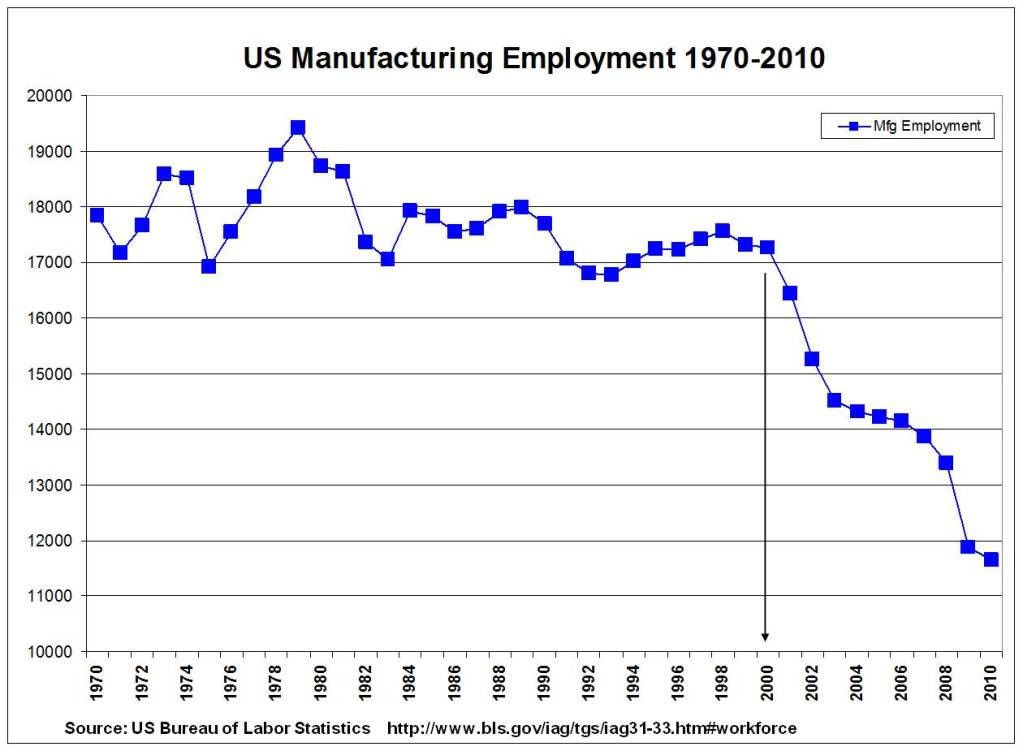
Manufacturing employment index also dropped 1.8 but still maintained its mid 50s range at 55.7%, and the trend set since a high in October of 57.7% is trending down. Surprisingly, Mike Shedlock just discovered that, "The long-term trend suggests it would be a mistake to expect too many jobs out of manufacturing." Mish provides a chart of employment in manufacturing (2000-2010), and for a longer time frame I include the following chart (From Manufacturing Employment.)


'Where Do We Go From Here' {Employment}
First came news that the ADP report says 297,000 jobs added last month which is the highest gain on record. And this led to increased estimates for the BLS report for last Friday to the "median forecast rising to 150,000". But there were caveats behind the strong ADP report.
But there is a seasonal quirk in the ADP number that may have inflated the December number. ADP and Macroeconomic Advisers do a seasonal adjustment that takes into account a typical December purge, where employers who have fired workers over the course of the year but don’t remove them from officials payrolls right away clear the rolls.

Ben Herzon of Macroeconomic Advisers explains: “If companies were laying off fewer employees throughout 2010 than had been the case in recent years, the amount by which the seasonal adjustment process subtracted from [ADP National Employment Report] growth last year through November was too great. Following the same logic, fewer layoffs through November implies fewer December purges than in recent years, so the boost to December employment growth to offset the normal December purge may have been too large.”

Then sure enough the BLS stated the following in their report at THE EMPLOYMENT SITUATION – DECEMBER 2010 {PDF}.
The unemployment rate fell by 0.4 percentage point to 9.4 percent in December, and nonfarm payroll employment increased by 103,000, the U.S. Bureau of Labor Statistics reported today. Employment rose in leisure and hospitality and in health care but was little changed in other major industries.

Even with the latest drop in the employment rate, it did not reach my prediction last January. At that time I stated, "I think headline unemployment percentage will slowly creep down over the next year to 9% and continue on that trend for the next couple of years." at Hawks Eating Humble Pie.

Mike Shedlock provides a jobs growth forecast for 2011 from Calculated Risk vs. Mish . Their predictions are as follows:
Calculated Risk:
This suggests to me that private payroll employment will increase by over 2 million jobs next year, maybe as high as 3 million jobs! My guess is around 2.4 million jobs as shown on the following graph.
Mish's Global Economic Trend Analysis:
I come up with +127,000 private jobs a month in comparison to Calculated Risk's estimate of +200,000 jobs a month. That is quite a difference.

I have total nonfarm jobs at +106,000.

Mish thinks that government employment will shrink by about 21,000 per month, or he is just dreaming a little about "hope and change". Mish comes to those conclusions mostly based on general trends over 2010. This might be good for a rough estimate but it may underestimate expanding sectors as they become the engine of growth in a turnaround economy. Paul Krugman takes a different approach by considering what growth rates would be needed to lower unemployment levels at The Long Road Ahead.
Roughly, it takes two point-years of extra growth to reduce the unemployment rate by one point.

So, suppose that US growth is accelerating. Even so, it will take years of high growth to get us back to anything resembling full employment. Put it this way: suppose that from here on out we average 4.5 percent growth, which is way above any forecast I’ve seen. Even at that rate, unemployment would be close to 8 percent at the end of 2012, and wouldn’t get below 6 percent until midway through Sarah Palin’s first term.

Interesting set of data points and also shows one of Krugman's deepest fear; that the business cycles will go against the Democrats and the Obama administration over the next few years with the Sarah Palin crack. That is, the economy will be still down and thus Palin wins the 2012 election and then during her first term provides growth prospects that insure reelection of her in 2016.

"Karl Smith" counters this line of reasoning by considering that high levels of unemployment now could easily translate to higher growth rates than what the US has been traditionally at Unemployment and Growth. This higher growth rate is derived from the "massive reservoir of untapped labor which could be easily mobilized". But the US has always had a massive reserve of untapped labor and that has been traditionally fulfilled by larger participation rates and immigration. This immigration has come from both legal as in the case of H1B visas and other special visas, and of course illegal immigration. The bigger problem is a matching problem of the skills that the massive reservoir of unemployed have presently and the skills of the new work force. Of course the structural rigidity of the US could prevent quick changes in the movement of capital from one sector to another.

Conclusion:
I am not certain that the time to panic about rising prices is upon us yet, but clearly there are signals that the Fed should be considering a change in the direction of monetary policy going forward. They need to be proactive and plan well in advance of changes in price levels. Even if unemployment is too high, they may need to start unwinding the monetary stimulus instruments. Under normal economic environments, fiscal and monetary policies should coordinate. But under situations like stagflation, then there may be a need for divergence between the two. Much as the early 1980s saw very restrictive monetary policy along with what could be considered fiscal stimulus.

Not only is manufacturing expanding in the US, and in the UK with a new 16-year high of 58.3 (more at UK Economy 2011), and in China where PMI expands, but momentum slows, but also "global manufacturing ended the year on a strong note". Only Japan and Greece were contracting out of the 23 countries listed, and 15 countries were experiencing raising index levels including Japan by 1%. While this is of course good for worldwide economic growth, it does portend that commodity prices could start to rise even more this year.

References:
ISM - Media Release: December 2010 Manufacturing ISM Report On Business®

ISM - Media Release: December 2010 Non-Manufacturing ISM Report On Business®


MarketWatch Data:
Manufacturing ISM Forecast: 57.5%
Non-Manufacturing Forecast: 55.6%


Supply Chain News: Are Manufacturers Really bringing Back Work to US? Anecdotes and some Data Say Yes – Even as Trade Deficits with China Rise; US Now has Total Cost Advantage in Some Areas, GE Executive Says


ISM Non-Manufacturing Index showed expansion in December

Misc. Links:
Fed Watch: A Solid Start To 2011


Manufacturing activity rises to 7-month high

The Plight of American Manufacturing Since 2001, the U.S. has lost 42,400 factories -- and its technical edge.
ManufacturingEmployment-1-1-1 ABQtom


Unlike Immigrants, Robots Will Permanently Drive Down Real Wages

Labor Market Commentary Arnold Kling
The Recalculation Story: A Summary Arnold Kling


ADP: +270k Jobs in Dec., Largest Gain on Record


Trade innovation: Invented threats | The Economist

An Interview with Robert Barro: "The Lessons from the Great Depression"

The Risk of Rising Oil and Gas Prices


Sci-Fi:
Robin Hanson on the technological singularity

Time to Read "Less Than Zero"
http://www.iea.org.uk/sites/default/files/publications/files/upldbook98pdf.pdf

Migration wages: more evidence
I reckon there are three policy implications here.
1. A cap on highly skilled immigration is a stupid idea.
2. Insofar as emigration reduces the wages of stayers, there is more reason to worry about the possibility that higher incomes taxes might encourage high earners to migrate. Fortunately, there is - so far? - little sign of them doing so, but this weakens a little my prior support for higher taxes.
3. It’s important to ensure that the capital stock can adjust upwards in response to immigration. Exactly how to do this is of course a matter of debate: is it more important to maintain aggregate demand and get banks lending, or to reduce red tape and capital taxes and barriers to entrepreneurship? Whatever the answer, the question becomes a little more important.

http://www9.georgetown.edu/faculty/ludemar/Wage%20effects_ozden.pdf

Labels: , ,

Tuesday, December 14, 2010

A Macro View: Perusal of Structural Rigidty.

The Macro View of the Markets has been spending a significant portion of its inches on the subject of Structural Rigidity {SR} and this post will be no exception to that pattern. This post will review some of the clues and areas of concern in regards to SR in the US, and then provide some other areas that may be hampering the flexibility of the US economy.

Review of Structural Rigidity Concerns:
From the others posts on SR, let me enumerate and review them here.
1. Some of the first clues looked at was in regards to manufacturing and non-manufacturing sectors of the economy through the ISM reports. The ISM reports were showing a picture of SR with the price index very high and maintaining a level close to 70 for the past several months, a high number of commodities reported in short supply along with most being longer term shortages as the multiple months' commodities grew, and slower supplier deliveries. And sure enough, the PPI was Hotter Than Expected.

2. Minimum wage increases prevent the formation of human capital. This also is a major contributor to the phenomenon of "sticky wages". This short article entitled Sticky Wages Hold Back Job Growth from the WSJ presents some of the reasons. Prices are the signaling device to markets of relative abundance or scarcity of resources. When prices become sticky then the market assumes there is not a shortage of labor and no reason to adjust the factor inputs in the production process. If capital became cheaper then we would see a shift in the inputs of capital and technology and possibly a shift away from as much quantity demanded of labor. The opposite is prevented in labor markets. Adam Ozimek provides some food for thoughts on the "structural labor market problems" at Lessons from South Africa’s Minimum Wage Problem. He makes the point that the people that do not get hired are the real losers if minimum wage is set above the market clearing price, especially for unskilled labor.

3. Mining and logging showed a more robust hiring than the other sectors and showed the least amount of increase for underemployed workers. Various moratoriums or over-restrictive regulations have prevented further developments in resource extraction industries. Of course, the BP oil blowout did not help the situation any also. It is also important when looking at various the components of SR to consider if the factors are converging indicating less SR or are diverging which could signify growing SR in the economy.

4. Regionally by the metro areas show some divergence in rates of unemployment. States also showed this divergence but it was shown that even if it was equalized the low unemployment rates states could not absorb even a significant fraction of the total army of unemployed as well as underemployed.


Other Areas of Probable Structural Rigidity:
This in no way is meant to be a complete list of bottlenecks or components of SR but just a first attempt at identifying some additional components.

1. The current economic slowdown has created a strong trend where men are losing jobs at a higher rate than women. Some have labeled it as "The Mancession" and most recently it was noted The Declining Demand for Men. These issues are related to structural rigidity, but are derived more from social and cultural norms, and practices. As such, these issues will continue with us for a long time no matter how much Warren Farrell wants to Save the males!

2. Natural resource extraction industries are notorious for rent seeking activity globally. The US is no different in that the entire complex rules, regulations, protectionism, taxes and yes subsidies distort the markets in hundreds of ways. This topic is too broad to cover all the areas and levels of these issues here, but an interesting aspect of it is when "Energy Leaders Blame Oil and Gas Subsidies for Weak Prospects". Some of the background information and facts are derived from the paper from "WWF for a living planet" at Fossil Fuel Subsidies. Upon careful reading of the analysis shows that they do identify negative externalities that are not factored into the price of gas and oil products. But they also imply that any reduction of tax rates below the maximum is a subsidy. Clearly it is not strictly a subsidy and often applied on marginally producing wells. Just as Alaska reduces or eliminates tax burdens on marginally producing wells.

3. Government rules and regulations in general prevent the reallocation of resources across sectors and the formation of new capital. John Stossel presents some good examples of these Regulations Overwhelming Small Businesses. Stossel also provides some interesting videos on his blog at Fox Business including an amusing one on how Government Kills Businesses.


4. Not only does governments at all levels stymie the formation of capital and thus creates structural rigidity, it also seems to be impeding the ability of government itself to maintain its investment levels. Mike Mandel shows how the average age of capital stock through the three aggregate broad sectors of residential, non-residential and government changed over the past 40 years at Our Aging Capital Stock.

Hat tip to Paul Krugman, who thinks that the problem has to do with the government "can’t muster the political will" at Build We Won’t. Karl Smith shows that it is not because a lack of funds available at Spending Money Can Be Difficult for Some Middle-Aged Governments. He talks about the fact that the US government can not seem to spend fast enough to increase aggregate demand. There are no "shovel ready projects" out there.

5. The US education system is basically characterized as a monopoly market provided by government and has not fundamentally changed in decades. From my own observations, it has been unresponsive to the new needs of business or even government presently. High school has been more of a holding cage than a place that will create skills and knowledge sets that allow graduates to compete in the global economy. But I am not sure what the answers to these dilemmas are.

Conclusion:
This post listed some of the structural rigidity issues covered so far on the Macro View of the Markets and briefly introduced some other areas for further consideration. Not only does it seem that government at all levels are getting in the way of capital formation and development but is also creating rigidity in its own ability to create public goods. This is a deterioration and degradation of "the commons". Instead of Krugman and his ilk screaming for more spending, he should be shouting about how inefficient government is becoming in providing public goods and services.

Structural rigidity can also be shown by social mobility or lack thereof. I close with some thoughts on the middle class from Samuel R. Staley at Fluidity And Mobility: A Newly Defined Middle Class.
Traditionalists have argued that dynamic, open-market economies are the most dependable institutions for vaulting individuals and households to a coveted level of income security, whether through entrepreneurship, homeownership, steady employment or the financial cushion of a pension or savings account. Now, these staples of social stability appear to be in jeopardy. That doesn't mean the aspirations have gone away, or that these aspirations don't motivate Americans in the workplace or the ballot box. Quite the opposite. The quest for economic opportunity, aspiring to enter the ranks of a new middle class, is in our cultural DNA.


Other links for Structural Rigidity.

Did the Minimum Wage Increase Destroy Jobs?

Census Data Shows Poverty Rates by State in 2009 - NYTimes.com

Economic growth: Importing job growth

Political Calculations: How Much Does It Cost to Employ You?

The USA falls in Forum Competitiveness Rankings


The USA falls in Forum Competitiveness Rankings


Fair Game: Blaming Older Workers for High Unemployment


Bailouts and Aggregate Demand presents the argument that bailouts are inconsistent with aggregate demand solutions and is more along the lines of aggregate supply solutions.

Economist's View: Stop the Unemployed from Becoming Unemployable


Block That Metaphor

Yep, It's Demand - NYTimes.com

Dollar: National Currency With State Implications - Real Time Economics - WSJ

Guest Contribution: 5 Reasons America Needs Korea Free Trade Deal

iPhone Adds $1.9 Billion to US Trade Deficit

Build We Won’t


Men-Women:
What's Going to Happen to Men?

United States of Wage Gaps - Map of the Gender Gap in Pay by State - NYTimes.com

The Biotech Advantage Why women start biotech firms at higher rates than they start other kinds of high-tech firms.

Labels:

Friday, December 10, 2010

Oil Exports and the Falsity of Headline Numbers.

EIA:
"A lie gets halfway around the world before the truth has a chance to get its pants on."
-- Winston Churchill

The problem then becomes that the truth is no longer considered a valid point of view or even open for discussion. The lie is so ingrained as it drowns out any hope that truth will appear. Take for example the myth that the US manufacturing base is collapsing. This lie is dispelled by the CFMMI Data Series from the Federal Reserve Bank of Chicago. Every decade the index (IPMFG) has been higher. That is, the index from the 80s was higher than the 70s, and the 90s was greater than the 80s, and 2000s was higher than the 90s. Even now the index is higher marginally than it was 10 years ago, even with the economic lost decade. This index is not affected by inflation and is growing on average faster than the population also.

The New Memes


That is simply stating the facts {from
Weekly U.S. Exports of Crude Oil and Petroleum Products (Thousand Barrels per Day)}. The problem becomes when this is interpreted to mean that prices in the US are too high because of shipping US finished petroleum products overseas. I could not find the incidence when oil executives were grilled on whether any oil products were shipped overseas during Katrina, but this article explains some of this type of reasoning: Senator Demands Detail on U.S. Oil Exports. First, Ron Wyden is looking for a scapegoat as the information about imports and exports are easily available at the U.S. Energy Information Administration but does not include firm level data.

Secondly, the falsity is that petroleum products exported are of the same quality and basis for the gasoline that goes into our cars. This forms the basis for an argument that goes the US should not drill in ANWR as most will be exported to Asian countries such as Japan. As a stable trading partner and political ally, I find no reason to not export whatever they are willing to pay for. But more importantly, what the US exports to Japan is mostly a by-product of the oil refinery process called petroleum coke. Over the last two years, around 75% of Japan's imports of petroleum products was petcoke. (You can find the information at:
Total Crude Oil and Products Exports by Destination.)

Where are the Exports Going?
Below is a list of countries by export volume with numbers included of average monthly exports in thousands of barrels and percentage increase of volume in the last two years vs. September 2005 to August 2008.

One thing to notice on this list is that a few of them, and most importantly the top two, are actually the top in exporting crude oil to the US in reverse order. Looking further down the list and specifically looking for large percentage increases, it is easy to see that many are small countries close to the US and/or also US suppliers. For example, Columbia, Costa Rica, and Nigeria increased their imports from the US by 346.25%, 349.40%, and 223.63% respectively. I would expect that their demand for processed petroleum products will continue to increase dramatically as they grow each of their respective economies.
What does this mean?
It means: it is best to take any factoid as just a starting point and that delving deeper into the numbers is a better practice. Just like the manufacturing sectors, the oil industry facts are often hidden behind emotions and simplistic explanation models. For example, the oil industry is stated as an oil monopoly when in fact it is better described as an oil oligopoly. Using Yahoo search engine for "oil monopoly" provides nearly 40 million results and for "oil oligopoly" provides a little over 400 thousand results. It seems more writers need to go back to Economics 101. One factoid is how the barrel of crude oil is broken down into its constituent parts as this next passage summarizes.
Crude Oil : A Breakdown of Refined Volumes
The largest share of the 42 gallons of crude oil ends up as a finished motor gasoline. Motor gasoline accounts for 19.65 gallons (~ 47%) of the finished products produced from a barrel of crude oil. Next is distillate fuel or diesel at 10.03 gallons (~ 24%) . A distant third is jet fuel at only 4.07 gallons per barrel (~ 10%) of crude. Residual oil is typically around 1.72 gallons per barrel (~ 4%).

Other petroleum products that are created from a barrel of oil during the refining process include: still gas, petroleum coke, liquified refinery gas, asphalt and various oils for lubricants, kerosene, waxes and other miscellaneous products. These "other" hydrocarbon products account for the final 15% of the barrel or around 6.53 gallons of the 42 gallon barrel.

The article goes on to explain that diesel is also a primary driver of crude oil demand. Thus the one that is in short supply given the market price will be the driver of quantity supplied to the market. This also may help explain why high income countries trade petroleum products across their borders in both directions. In the short list above we saw the US exporting to Netherlands, Singapore, and Japan. Further down the list included countries such as Spain, France, Germany and Greece.

If the US wants to upset our suppliers of crude, or our trading partners, or even small nations in the region then it might be a good idea to restrict exports of petroleum products. But if want the efficiency of the markets to work, then the US needs to encourage more domestic production of refined petroleum products. This a value added product that uses our depth of human capital as well as extensive amounts of capital, while leaving our trading partners opportunities to specialize in what they do best. The breadth and depth of petroleum products, including all the blends of gasoline, makes the US a natural for increased specialization in this export area. Of course, this is a sector that could be called structurally rigid.


Misc. Links:
U.S. Imports & Exports
U.S. Total Crude Oil and Products Imports

BizzyBlog

Weekend Reading – Santa Clause Rally or Grinchy Finish to 2010? | Phil’s Stock World

IS THE ISM NEW ORDERS:INVENTORIES SENDING RECESSION WARNING?

How to Read the Data: ISM Manufacturing Orders vs Inventory

Fake-Out Thursday – Oil Scam Continues Unabated - Phil's Favorites

Labels: , ,